News & Updates
-
POSTECH Professors Beomjun Choi and Changsoon Cho Selected for Samsung Science and Technology Program 2023
Professors Beomjun Choi from the Department of Mathematics and Changsoon Cho from the Department of Materials Science and Engineering at POSTECH have been chosen to participate in Samsung Electronics’ Samsung Science and Technology Program for the latter half of 2023. Professor Beomjun Choi’s research, titled “Lojasiewicz’s Theorem and Uniqueness Conjectures for Asymptotics of Differential Equations” was selected in the fundamentals category while Professor Changsoon Cho’s research on “High Resolution and High Color Purity Nanoscale Photoluminescent Display Using Plasmon Transfer” was chosen in the materials category. Both projects will receive support during the second half of the year. Professor Beomjun Choi completed his Ph.D. at Columbia University in 2019 and has been teaching POSTECH students since 2021, following his academic journey at the University of Toronto and Korea Institute for Advanced Study of the KAIST. He was honored with “Sangsan Young Mathematician Award” from the Korean Mathematical Society in 2021 and was also recognized as a “2022 POSCO Science Fellow.” Professor Changsoon Cho, who majored in electronic engineering at the KAIST, joined the faculty of POSTECH this year. Prior to this, he was affiliated with the University of Cambridge in the U.K. and Technische Universität Dresden in Germany. The program is Samsung Electronics’ initiative to contribute to society by advancing fundamental scientific knowledge and nurturing exceptional scientist and engineers. Since 2013, Samsung Electronics has consistently identified and supported innovative and challenging research projects twice annually during the first and second halves of the year. In the first half of this year, Professor Ara Koh from POSTECH’s Department of Life Sciences was selected to participate in the program.
2023.10.31 2273 -
POSTECH – Ulsan College of Medicine Joint Team Wins at MICCAI 2023
A joint team of researchers from POSTECH and Asan Medical Center of the University of Ulsan College of Medicine recently achieved remarkable results at the MICCAI 2023, a global competition in medical artificial intelligence, organized by the Medical Image Computing and Computer Assisted Intervention (MICCAI). Comprising of eight researchers from two institutions, the team clinched first place in the ultrasound image enhancement category by using deep learning models. Furthermore, they secured the second spot overall in the category focused on detection, segmentation, and classification algorithm of breast tumors in three-dimensional ultrasound images. The team’s innovation, MUST GAN*1, combines the Cycle GAN*2 model with the reconstruction model, raising the quality of home ultrasound images to a level on par with hospital-grade ultrasound images. To achieve this, the researchers employed the three-dimensional (3D) Multi-task U-Net*3 model, which enables simultaneous segmentation and classification of multiple organs in the image. Professor Chulhong Kim of POSTECH explained, “This partnership will expedite our collaborative research on ultrasound medical AI models with a team led by Professor Namkug Kim from the University of Ulsan College of Medicine.” He added, “We’ll strive to harness our advanced AI technology for practical applications in the field of medicine.” MICCAI, the renowned conference in the realm of medical artificial intelligence, serves as a global gathering for researchers and medical professionals in the AI domain. This year’s competition, hosted in Vancouver, Canada, attracted research teams from prestigious universities worldwide including Seoul National University, the University of California, Los Angeles, the Beijing Institute of Technology, and Deutsches Krebsforschungszentrum, the German cancer research center. △ POSTECH researchers: Hyunsoo Jeong, a doctoral student, and Abhijeet, a postdoctoral fellow, from the Graduate School of Artificial Intelligence, Hyunseok Lee, a researcher in the Department of Convergence IT Engineering, and Cheeho Yoon, a doctoral student of the Department of Electrical Engineering (Advisor: Professor Chulhong Kim) △ researchers from the University of Ulsan College of Medicine: Jeehoon Jeong (advisor: Professor Joongu Lee), Jongjoon Won and Changyong Choi (advisor: Professor Namkug Kim), and Youngjae Kim (advisor: Professor Sangmin Lee)- all M.S. students in Biomedical Engineering. 1. MUST GAN (Multi-domain Ultrasound Style Transfer GAN) A learning approach based on Cycle GAN, which also performs classification tasks while incorporating insights from the reconstruction model. 2. Cycle GAN (Cycle Generative Adversarial Network) A method for learning by cyclically translating between two image datasets that lack one-to-one correspondence. 3. Multi-task U-Net A technique that extracts features from input images through both an encoding phase (reducing image size) and a decoding phase (enlarging it), producing segmented results of the original image while also training for classification tasks.
2023.10.31 2181 -
Swedish Ambassador Daniel Wolvén Gives Talk at POSTECH
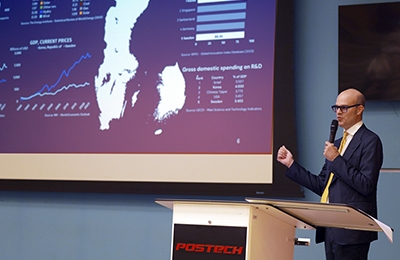
On October 12, Swedish Ambassador to Korea Daniel Wolvén gave a special lecture at the POSCO International Center at POSTECH. Ambassador Wolvén gave a presentation on Sweden's latest research focus titled, Small, Smart Countries - The role of Sweden and Korea in a rapidly changing world. In his talk, he emphasized the importance of building a foundation to promote research and educational cooperation and exchange between Korea and Sweden. The event had an excellent turnout with about 180 university members attending the lecture, which was followed by a robust Q & A session. The attendees had the opportunity to think about how small but powerful countries such as Sweden and Korea can grow through cooperation with other countries and have a positive influence on each other.
2023.10.24 2298 -
Professor Jeehoon Han’s Paper in Top 10% of Highly Cited Articles
Professor Jeehoon Han from the Department of Chemical Engineering at Pohang University of Science and Technology (POSTECH) had his paper featured among the top 10% of highly cited articles in Energy & Environmental Science, an academic journal. Professor Han’s study, conducted in 2021, focused on building biorefinery infrastructure that transforms food waste into eco-friendly fuel. His comprehensive sustainability assessment methodology for the life cycle gained attention in academic circles. In his research, Professor Han also predicted the carbon footprint of 175 countries by 2030 and demonstrated the production of green hydrogen in nations with abundant food waste, which was successfully used to power vehicles equipped with fuel cells. Professor Han received his Ph.D. in chemical engineering from POSTECH and has been teaching at POSTECH since 2022. Energy & Environmental Science is a highly influential journal in the field of energy science, boasting an impact factor of 39.7.
2023.10.20 2305 -
POSTECH’s Professor Moon Jeong Park Receives the Toray Mid-Career Award
Professor Moon Jeong Park from the Department of Chemistry at Pohang University of Science and Technology (POSTECH) was honored with the Toray Mid-Career Award. The award was presented in the morning of October 12, 2023 at the fall general meeting and conference of the Polymer Society Korea that took place at the Jeju International Convention Center, Korea. Renowned for her research in polymer chemistry including the synthesis and analysis of polymer electrolytes and correlations between ion channel structure and conductance, Professor Park has gained recognition for her contributions to the field of charge transport polymers both in academia and industry. Professor Park earned her B.S., M.S., and Ph.D. degrees in chemical and biological engineering from Seoul National University and has been teaching at the Department of Chemistry at POSTECH since 2009. Notably, Professor Park holds the distinction of being the first Korean to receive the American Physical Society’s (APS) John H. Dillon Medal*1 and was elected as an APS Fellow in 2021. This year, she also became the first professor from a foreign university to be elected as the Senior Vice President of the APS’s Division of Polymer Physics. The Toray Mid-Career Award, established this year, recognizes exceptional research published within the last 5 years and is presented to researchers who have made remarkable contributions to the field of polymer science and technology. The recipient of the award is honored with a certificate and a prize of 5 million won (USD 3,700). 1. Dillon Medal An annual award presented to a young scientist who has received their Ph.D. within the past 12 years and has demonstrated outstanding achievements in the field of polymer physical chemistry.
2023.10.20 2230 -
Professor Chunghyoung Lee’s Paper Selected as Top Ten Papers of 2022 by Philosopher’s Annual
Professor Chunghyoung Lee from the Division of Humanities and Social Sciences at Pohang University of Science and Technology (POSTECH) achieved recognition for his paper as it was selected as one of the top ten philosophy papers of 2022 by the Philosopher’s Annual. The Philosopher’s Annual annually selects a list of 10 best philosophy papers worldwide based on recommendations from journal editors in the field, a tradition dating back to 1978. Last year, Professor Chunghyoung Lee published a paper in the Philosophical Review which earned a spot among the top ten philosophy papers of the year. His paper delves into the status of fertilized eggs and early embryos (Paper title: I am not the zygote I came from because a different singleton could have come from it). In his paper, Professor Lee applies logical and metaphysical principles of possibility and inevitability to recent discoveries in developmental biology. Through this analysis, he provides new insights and arguments concerning the personhood of a fertilized egg or early embryo. He explores whether it should be considered as a person and, if so, whether it is comparable to a newborn and an adult. Professor Chunghyoung Lee received his bachelor’s degree in physics from Seoul National University and his doctorate in philosophy from the University of Minnesota. He worked at California State University, Fresno and Kyung Hee University before joining the faculty of POSTECH in 2016.
2023.10.20 1921 -
Heegon Kim Honored with Best Paper Award at APNOMS 2023
Heegon Kim, a PhD candidate from the Department of Computer Science and Engineering (advisor: Professor Won Ki Hong) at Pohang University of Science and Technology (POSTECH), received the Best Paper Award at Asia-Pacific Network Operations and Management Symposium (APNOMS) 2023 held at the Government Complex Sejong Convention Center in Korea. Heegon Kim showcased his research on utilizing machine learning models to predict network traffic and design effective service*1 resources management strategies (Paper title: Network Traffic Prediction and Auto-Scaling of SFC Using Temporal Fusion Transformer). APNOMS, celebrating its 24th year this year since its inception in 1997, remains the premier international conference in the Asia-Pacific region dedicated to network operations management. 1. Service A software component that provides various functionalities including software applications, web services, microservices, or other computer program or functions.
2023.10.20 1908 -
Prof. Seung-Hwan Baek Receives Frontiers of Science Award at the First ICBS
Professor Seung-Hwan Baek of Computer Science at Pohang University of Science and Technology (POSTECH) has been honored with the Frontiers of Science Award in the field of Computational Optics at the inaugural International Congress of Basic Science (ICBS), held in Beijing, China. The Frontiers of Science Award is awarded to distinguished scientists who have made outstanding contributions across a spectrum of 34 distinct domains, spanning mathematics, theoretical physics, theoretical computer science, and information science, over the preceding five years. Professor Baek's achievement is attributed to his participation in research led by Ethan Tseng of Princeton University's Department of Computer Science in 2021. The outcome of their collaborative efforts was published in Nature Communications under the title of “Neural nano-optics for high-quality thin lens imaging.” At that time, the research team created lenses smaller than a single grain of rice and miniscule cameras in the nanometer range, all achieved by using artificial intelligence technology. This interdisciplinary confluence of computer vision, nano-optics, and AI underscores the potential of minuscule cameras going forward while also attracting attention by being featured in the Top 30 Ideas in Optics by Optica. The ICBS, launched this year to promote the collaboration and knowledge exchange among leading scientists worldwide, brought together some 1,000 researchers, including recipients of the Fields Medal, Turing Award, and Nobel Prize.
2023.10.13 2641 -
The 20th POSTECH-KAIST Match: Where Science and Engineering Excellence Converge
["Through competition, the event offers a unique opportunity for participants to foster a sense of belonging, pride, and to strengthen the bonds among engineering students.”] The POSTECH-KAIST Student Festival (POKA Match), a recurring exchange event between Korea's top science and engineering universities, will take place at KAIST's Daejeon campus for a two-day event beginning on September 22, 2023. Since its inception in 2002, the POKA Match has served as an exchange platform, allowing students from both KAIST (President Kwang Hyung Lee) and POSTECH (President Seong Keun Kim) to foster friendship and demonstrate their unique talents and skills through science competitions, sports, and e-sports. The annual POKA match, held in September, rotates between Daejeon and Pohang with the name this year following the tradition of placing the away university's name first. This event, often dubbed the “Science War,” draws the brightest minds in Korea's science and engineering community. It features a variety of science-related activities including hacking, an artificial intelligence (AI) contest, a science quiz, and three ball games - baseball, football, and basketball. In total, seven events are scheduled including an e-sports competition (League of Legends). The hacking competition spans 12 hours from 3 PM on the first day until 3 AM the following day. It operates on a Capture The Flag (CTF) format where participants accumulate points by discovering vulnerabilities in the opponent's system or decrypting passwords to locate hidden flags. The artificial intelligence (AI) contest involves modifying some rules of the board game Quoridor. Each university designs AI programs to strategize movement and assess positions on a 9-by-9 board with victory going to the team that reaches the opponent's camp first. In this year's competition hosted by KAIST, an addition to the official schedule is a friendly badminton match set for the morning of September 23. Furthermore, the e-sports competition, traditionally held on campus, will be relocated to the Daejeon E-sports Stadium. This move to a dedicated venue enhanced not only the players' focus but also the audience's overall immersive experience. Moreover, the science quiz game, previously exclusive to players, will be expanded to include an audience quiz event. This modification is to encourage more students to participate in the POKA match. The university claiming the overall championship must secure victory in four or more events. Currently, KAIST leads with a record of 10 wins and 8 losses overall, excluding the cyber exchange games held in 2020 and 2021 during the COVID-19 pandemic as well as a draw in 2009. Seungmin Shin, the head of the POKA match planning team and who was accepted to KAIST's Department of Electrical and Electronic Engineering in 2021, explained, "We anticipate participation from over 1,000 students including athletes and cheering squads from both schools in this year's POKA competition. Through healthy competition, they will develop a sense of belonging and pride, forging strong bonds among engineering students.”
2023.10.06 2306 -
Raising Global Semiconductor Experts
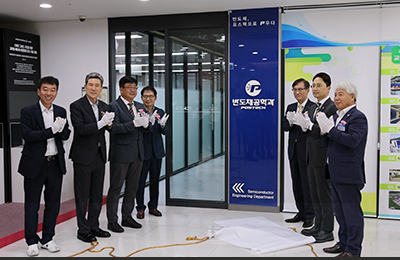
[POSTECH’s Department of Semiconductor Engineering hold opening ceremony] [Department plans to become central hub for next-generation semiconductor research and develop leading research group on a global scale] The opening ceremony for the Department of Semiconductor Engineering at the Pohang University of Science and Technology (POSTECH) took place on September 15, 2023. The opening ceremony was attended by Pohang Mayor Lee Kang-deok, Pohang City Council Chairman Baek In-gyu, Kim Byung-wook, National Assembly member representing Pohang City, Hyuk-Jun Choi, Director-General of Metaverse and Science Bureau of Gyeogsangbuk-do, Samsung Electronics Vice President Kim Seon-sik, Seong Keun Kim, President of POSTECH, and Byung Hun Lee, Head of POSTECH’s Department of Semiconductor Engineering. POSTECH’s Department of Semiconductor Engineering offers specialized education covering all aspects of semiconductor technology including devices, materials, processes, and circuit design. It is Korea's exclusive institution offering a comprehensive six-year program, encompassing three years for a bachelor's degree and three years for both master's and doctoral degrees. Students will undergo practical training at Korea's largest semiconductor education and research facility. Approximately 20 professors from POSTECH will oversee this training. During his welcoming address at the opening ceremony, Seong Keun Kim, the president of POSTECH remarked, “With the world's premier semiconductor infrastructure, our Department of Semiconductor Engineering sees the global race for semiconductor hegemony as an opportunity for a new leap forward." He added, "We will collaborate closely with the local community to fortify the national semiconductor ecosystem and contribute to regional growth.” Furthermore, Professor Byung Hun Lee, Head of the Department of Semiconductor Engineering, outlined his vision to establish “one of the top five globally renowned nanosemiconductor convergence research institutes” through collaboration between academia and industry. The Department of Semiconductor Engineering, established with support from Samsung Electronics, annually enrolls 40 undergraduate students. The admission rate for the 2024 early action entrance examination stood at 10.225 applicants for every available spot.
2023.09.27 2490