News & Updates
-
Prof. PooGyeon Park’s Article Most Cited in Automatica Since 2010
When several electronic devices are linked through fixed and mobile connections, time-delays inevitably occur due to the limitation of data transmission speed; it is known that systems with these types of aftereffects often experience instability or performance degradation. Substantial research efforts have been made to tackle this problem and POSTECH researchers are reported to have provided an important foundation for the related literature. An article published by Dr. PooGyeon Park, a professor of the Department of Electrical Engineering at POSTECH, was selected as the most cited article in Automatica for the past five years. Widely known as one of the leading international peer-reviewed journals in the field of systems and control, along with the IEEE Transactions on Automatic Control, Automatica has a noteworthy impact on other fields of science and technology. According to Scopus, the largest citation database in the world, Park’s paper on a reciprocally convex approach to stability of systems with time-varying delays has been cited 398 times since its publication in 2011. The second most-cited article, although published a year earlier than Park’s, was cited no more than 316 times showing that the academic community has taken more notice of Park’s findings. Park’s research has much improved the accuracy in judging the stability of systems with time-varying delays. In the field of automatic control, stability of time-delay systems (TDS) is a key question; yet, previous studies have reported much difficulty in finding the minimum value of inverse convex combination, which is a critical piece of information in judging the stability for the systems with time-varying delays. The common practice, therefore, was to find the minimum by approximation until Park suggested a new lower bound lemma and provided a basis for a stability criterion that directly handles the inversely weighted convex combination. Automatica makes monthly announcements of most cited articles featured in the journal in the past five years, and Park’s paper was ranked top among articles that were published since January 2010.
2015.07.15 3162 -
POSTECH Summer Classical Concert with Maestro Nanse Gum
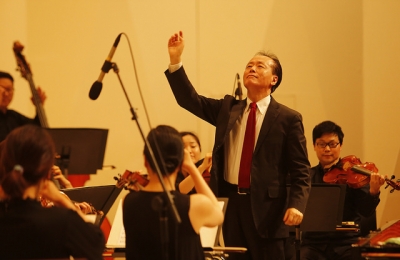
Many guests visited the POSTECH campus to enjoy a good classical tune on a rainy summer afternoon as POSTECH held its annual classical concert with Maestro Nanse Gum in the Auditorium on Sunday, July 12. Providing the local community and campus members with an opportunity to enjoy great performances and enrich their cultural experiences, POSTECH has been inviting Maestro Nanse Gum and the Euro-Asian Philharmonic Orchestra every summer since 2009. Maestro Nanse Gum, who is a world-renowned musician, is known as the most beloved Korean conductor and the father of popular classical music in South Korea. This year, under the theme of “The Carnival of Classic with Maestro Nanse Gum,” the orchestra performed The Carnival of the Animals (Le Carnaval des Animaux) by the French Romantic composer Camille Saint-Saens. The dynamic organization of the piece and instruments’ sounds that mimic different animals captured the audience’s attention. Maestro Nanse Gum’s easy commentary also brought the music much closer to his audience. Sponsored by KISWIRE Ltd., the concert was open to the public without fee.
2015.07.14 2461 -
POSTECH Lends Hands to Sookmyung Univ. for New Engineering School
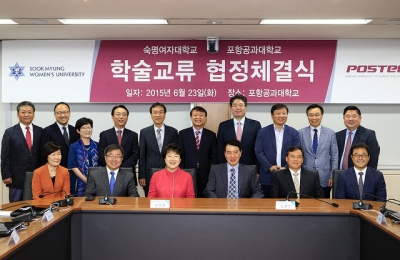
POSTECH entered a Memorandum of Understanding with Sookmyung Women’s University (SWU) on Tuesday, June 23, endorsing efforts to nurture female talent in STEM (Science, Technology, Engineering, and Math) fields. As SWU has launched a grand plan to open a new college of engineering scheduled to admit entering students starting next year, POSTECH has agreed to share with SWU its know-how and experience as a STEM-focused research-oriented university that rapidly rose to become a world-class university within less than three decades. The newly formed partnership is aimed at supporting SWU to build a strong foundation for the new engineering college and provide high-quality STEM education for talented young women. Under the MOU, the universities will collaborate in joint academic and research efforts, exchange of faculty and students, transfer of academic credits, and joint-degree programs. POSTECH and SWU further plan to explore new territories in converged research that brings together each university’s strengths. “We welcome and support SWU’s initiative to establish a college of engineering for women. We could definitely use more talented women in STEM fields,” commented President Yongmin Kim of POSTECH. President Kim also shared his hope that “this newly formed partnership will serve as the platform for POSTECH and SWU to closely collaborate to build a strong foundation for mutual growth”. Sun-hye Hwang, president of SWU, emphasized, “We see more participation of women in all aspects of society today, but it is also clear that there still remains a lack of female representation and accordingly a need for more female talent in engineering and technology.” It is President Hwang’s resolution that “SWU will stand at the forefront of women’s advancement.”
2015.07.14 2422 -
A Cool Way to Form 2D Conducting Polymers Using Ice
POSTECH scientists develop breakthrough technique to easily optimize electrical properties of Polyaniline nanosheets to an unprecedented level in an environmental-friendly and inexpensive way. A piece of deep frozen ice and electronic gadgets may seem to have little connection (except that they are both ‘cool’ to have on you), but ice could now play a role in opening a new era in the electronic industry where conducting polymers, simply put plastics with electrical properties, are in great demand for practical applications. Chemists at Pohang University of Science and Technology (POSTECH), Korea, have discovered an innovative method to form two-dimensional polyaniline (PANI) nanosheets using ice as a hard template. The product, called PANI-ICE, is reported to have distinctly outstanding electrical properties of low resistivity and high conductivity. PANI-ICE nanosheets show high electronic current flows twice as high as that of graphene, widely known as a next generation dream material, and over 40 times higher conductivity of PANI materials produced by existing established synthetic procedures. Among various conducting polymers, PANI has long been a promising candidate for practical applications, in particular for microelectronics and battery electrodes, due to its relatively facile chemical synthesis and easy doping process at a low financial and environmental cost compared to other materials. As PANI’s electrical properties are known to largely depend on its structure, previous studies have focused on the successful fabrication of two-dimensional PANI nanosheets using graphene oxide (GO) as a hard template. Despite improved electrical properties, however, the high cost, complexity of synthetic procedures, and unreliability of electrical properties over a large area are pointed out as the downside of PANI-GO composite nanosheets. Difficulties in removing the graphene oxide template also hinder versatile formation of the products. Dr. Moon Jeong Park, a professor of the Department of Chemistry at POSTECH, and her two doctoral students, Il Young Choi and Joungphil Lee, have recently presented an innovative method that effectively overcomes the disadvantages of existing approaches. Selected as a “Highly Important Paper” of Angewandte Chemie, an internationally acclaimed peer-reviewed journal, Park et al.’s study is drawing much attention. Park et al. fabricate PANI nanosheets on a smooth surface of deep frozen ice, causing preferential vertical growth and molecular orientation of PANI that significantly enhances its electrical properties. The superior conductivity of PANI-ICE, in particular, outperforms that of any other existing PANI ever reported. Moreover, the fabricated nanosheets can be easily transferred to various types of substrates as they float off on the surface of an ice template. It is also noteworthy that nanosheets can be patterned into any shape when using prearranged masks. By simply introducing an easily removable, environment-friendly ice template, Park et al. successfully tackled a major challenge in the commercialization of conducting polymers, which is to improve both electrical properties and processability. What is more impressive about Park et al.’s original approach is that the synthesis of a large area only takes a few minutes and allows the production of one square meter of PANI-ICE nanosheet at a cost lower than $8 (USD). “We believe that these unique, unprecedented advantages of PANI-ICE can expedite the eventual convenient and inexpensive application of conducting polymers in versatile electronic devices,” said Park, the leader of study. Park et al. next plan to experiment on small pitch sizes of the nanosheets and further develop their research on the applications for electrodes in various electronic devices such as actuators. This work was supported by the Samsung Research Funding Center of Samsung Electronics.
2015.07.07 2713 -
Prof. Yoon-Seok Chang Finds Fetuses More Vulnerable to Some Environmental Contaminants Penetrating Into Cord Blood
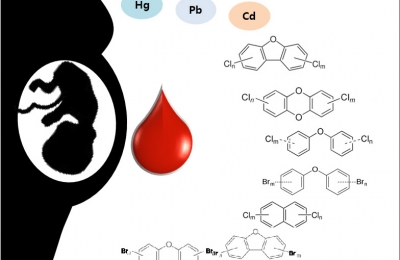
Toxic environmental contaminants are increasingly known to cause a number of severe health problems, in particular on fetuses, including heart failure, low cognitive ability, delayed development, and neurobehavioral disorders. A new research featured in the Environmental Science and Technology published by the American Chemical Society suggests that the fetus is more vulnerable to some pollutants with certain properties because they penetrate further into the feto-maternal system. The research found that distributions of pollutants and the mechanisms of distributions vary depending on each pollutant’s physicochemical characteristics. Led by Dr. Yoon-Seok Chang, a professor of the School of Environmental Science and Engineering at Pohang University of Science and Technology (POSTECH), Korea, the research team analyzed a series of persistent organic pollutants (POPs) and heavy metals in the samples of cord blood, maternal blood, maternal urine, and placenta from new-born babies and their mothers. The contaminants include mercury, lead, cadmium, dioxins (PCDD/Fs, PBDD/Fs), dioxin-like compounds (PCNs, PCBs), and brominated flame retardant (PBDEs). By looking into the concentration levels of toxins in each part of the feto-maternal system, Dr. Chang and the researchers have confirmed that all pollutants in the mother’s blood are transported to the fetus through the placenta and cord blood. Despite the fact that most of the contaminants are slightly filtered when passing through the placental barrier, all heavy metals seem to easily pass through the barrier. Lead is hardly affected, and mercury accumulates even more in the fetal blood than the maternal blood due to its binding affinity to fetal proteins. PBDEs are similarly detected higher in the cord blood due to its unique distribution mechanisms strongly associated with the thyroid hormone, deduced by the researchers. The study has also brought much deserved attention to the prenatal exposure to POP candidates, of which no previous studies seriously considered, as PCNs and PBDD/Fs are detected in the cord blood for the first time. PCNs and PBDD/Fs’ dioxin-like structure and growing discharge into the environment are worthy of public concern. “When environmental contaminants are accumulated in a pregnant mother, the fetus is also directly exposed to them, meaning the adverse effects of POPs and heavy metals last generation after generation,” says Dr. Chang, the leader of this study. While planning on follow-up research for more comprehensive understanding of the distribution, interrelation, and health effects of various contaminants, Dr. Chang has emphasized efforts to reduce human exposure to and discharge of environmental contaminants. Titled “Partitioning Behavior of Heavy Metals and Persistent Organic Pollutants among Feto-Maternal Bloods and Tissues,” this study was supported by the National Research Foundation, Korea and by the Environmental Health Action Program of the Korea Ministry of Environment.
2015.06.26 2427 -
Symposium on Environmental Policy Held at POSTECH
POSTECH hosted on June 1st a symposium on environmental policy for professionals and researchers in the fields of environment and energy. Held at the POSCO International Center on campus, the symposium brought together many experts from industry, academia, and research organizations. Some of the participants included President Won-hoon Park of the Association of Academics and Societies of Sciences in Asia (AASSA), Dr. Byong Kwon Park, an advisory member of the Ocean Policy Institute of the Korea Institute of Ocean Science & Technology, and President Sang-eun Lee of the Korean Academy of Environmental Science. Senior Executive Vice President Kyung-Hoon Lee and Dr. Kil-Choo Moon, former President of Korea Institute of Science and Technology, also participated. The symposium provided an opportunity for environment and energy researchers to hear from the experts on the outlook and approaches for environmental policy. “We hope that the lectures and discussions from this symposium would much benefit participating researchers in their competition for high technology in the environment and energy sectors,” commented Professor Yoon-Seok Chang from the School of Environmental Science and Engineering at POSTECH.
2015.06.22 2276 -
Adrian Normanton Award Goes to Professor Sung-Mo Jung
Professor Sung-Mo Jung of Graduate Institute of Ferrous Technology received the Adrian Normanton Award from the Institute of Materials, Minerals and Mining (IOM3). Newly established last year in recognition of the late Dr. Adrian Normanton, a renowned UK steel engineer, the award is given for the best technical paper on the topic of steelmaking or casting presented in Ironmaking & Steelmaking: Processes, Products and Applications published by IMO3. Professor Jung was named the Adrian Normanton Award winner for 2015 for his paper on the effect of surface roughness of MgO substrate on the formation and size distribution of inclusion particles. Professor Jung shed light on the reaction mechanism and suggested a new experimental methodology to clarify the effect of the surface roughness. After earning his bachelor, master, and doctoral degrees at POSTECH and postdoctoral study at Carnegie Mellon University, Professor Jung came back to POSTECH in 2000 for a faculty position. His specialty includes reaction equilibria and kinetics on ironmaking and steelmaking as well as the application of physical chemistry to refining processes in ferrous technology.
2015.06.22 2483 -
Professor Jong-Ram Lee Named Inventor King of the Year
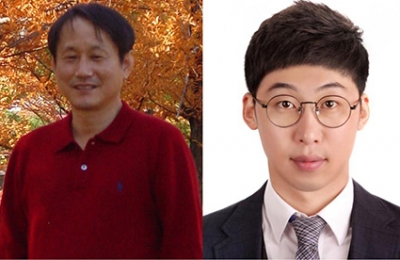
POSTECH Professor Jong-Ram Lee (Dept. of Materials Science & Engineering) received the Inventor King of the Year Award (a Presidential Citation) from the Korean Intellectual Property Office (KIPO) at the 50th Anniversary Ceremony for Korea Invention Day on May 19th, 2015. Mr. Baekhee Lee, a Ph.D. student in the Dept. of Industrial Management & Engineering, also received the Minister of Science, ICT and Future Planning’s Citation at the ceremony. KIPO selected Prof. Jong-Ram Lee as the winner this year for his contribution to the commercialization of next-generation flexible electronics. Prof. Lee has developed a key technology in flexible displays, which enables the production of extreme flat metal substrates. This technology has received much attention and recognition including the Special Award (World Intellectual Property Organization General Director’s Citation) at Korea Invention Patent Exhibition 2010. Mr. Baekhee Lee was presented with the Minister’s Citation for two of his smart healthcare products: 1) i-care, a PC based visual field testing system for early detection of glaucoma; and 2) a mobile swallowing monitoring and assessment system (mobile-SMAS) for diagnosis of dysphagia. Mr. Lee’s inventions have been highly considered at various domestic and international contests and exhibits. Held along with other various invention-related events to celebrate the Invention Week (May 12-19), the annual ceremony shed light on the importance of inventors and their contributions to society.
2015.06.04 2421 -
Professor Taihyun Chang Wins SPSJ International Award
POSTECH Professor Taihyun Chang (Dept. of Chemistry) was named the winner of the SPSJ International Award by the Society of Polymer Science, Japan (SPSJ). Established in 1994, SPSJ International Award is the highest honor given by the society to international scientists for their contribution to the development of polymer science and related fields. In recognition of his significant impact on the field of polymer separation and analysis, Prof. Chang was presented with the award at the SPSJ Annual Conference on May 28th in Sapporo, Japan. Prof. Chang received his Ph.D. in physical chemistry from University of Wisconsin-Madison in 1984 and worked at the Polymers Division in the (U.S.) National Bureau of Standards and Korea Research Institute of Chemical Technology before taking a faculty position at POSTECH in 1988. Using various detection methods such as high performance liquid (HPLC), Prof. Chang succeeded in rigorous separation and analysis of polymers, which was deemed impossible before. Based on this technique, he has further solved other major problems in polymer science including analysis of each block in block copolymers. His research on the self-assembled nanostructure of precisely controlled block copolymers and rheological properties of non-linear polymers via precise HPLC separation, in particular, has created a huge sensation in the academic community. Commemorating his nomination for the award, Prof. Chang delivered at the conference a keynote speech themed “Innovative Approaches to Molecular Characterization and Separation of Polymers by Chromatographic Techniques.”
2015.06.04 2565 -
POSTECH Joins Hands with Korean Web Giant NAVER
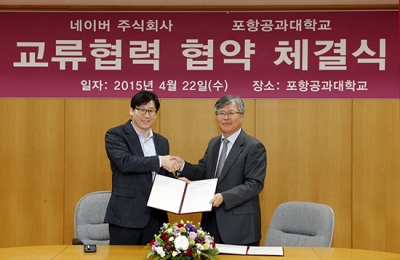
POSTECH Joins Hands with Korean Web Giant NAVER POSTECH, a leading science and technology university in South Korea, signed a Memorandum of Understanding (MoU) with NAVER Corporation (NAVER), on Wednesday April 22, with the goal of fostering the next generation of computer scientists and engineers. Operating South Korea’s biggest search portal, NAVER is also well known for its mobile messenger service ‘Line,’ which has 180 million active users worldwide. Strongly committed to the continuous identification and development of talent in computer science and engineering related fields, both POSTECH and NAVER have agreed to establish comprehensive programs of support, starting with a Young Faculty Fellowship to fund junior faculty members’ research. Scholarships for graduate students and outstanding undergraduate students are also under way. Under the MoU, the Academia-Industry collaboration will reach further into the classroom. NAVER will provide POSTECH students with courses and project mentoring by their experts as well as programming camps, field trips, and internship opportunities. Startup initiatives and student activities such as hackathon are also strongly endorsed to help students discover and develop their career paths. D2 Startup Factory, NAVER’s tech startup accelerator and investment program, will be open to POSTECH students. By joining hands with the nation’s leading internet company, POSTECH expects to bring more outside expertise and on-field experience onto campus and build a stronger system to cultivate computer scientists and engineers. NAVER, on the other hand, anticipates that the partnership will contribute to further leveraging its core technologies including deep learning, voice recognition, machine translation, and web browsing. The two parties expressed their strong will to continue to develop and expand their collaboration to solidify the support ecosystem.
2015.04.28 2609