Research Highlights
Self-Regenerating Catalyst Overcomes Key Durability Challenge in Hydrogen Energy
- Materials Science & Engineering Ferrous & Eco Materials Technology Battery Engineering
- Date2026.06.11
- Views657
[POSTECH-led research team develops IrFe/C electrocatalyst
that self-heals after oxidation, dramatically improving durability of water electrolyzers and fuel cells]
Imagine a catalyst that can heal itself after being damaged. A POSTECH-led research team has developed an innovative electrocatalyst that regenerates its own metallic surface after oxidation, much like how a wound heals naturally. This breakthrough addresses one of the most critical challenges in hydrogen energy technology: the irreversible degradation of catalysts during operation.
Professor Yong-Tae Kim from the Department of Materials Science and Engineering and the Graduate Institute of Ferrous & Eco Materials Technology at Pohang University of Science and Technology, together with Professor Sang-Hoon You of the Department of Mechanical and Automotive Engineering at Kongju National University, Professor Jeong Woo Han of the Department of Materials Science and Engineering at Seoul National University, and Dr. Kug-Seung Lee of the Pohang Accelerator Laboratory, have developed an iridium-iron alloy catalyst (IrFe/C) that overcomes the irreversible degradation of electrocatalysts through dynamic segregated-surface reconstruction. Their research has been recognized for its excellence and published as the front cover of the prestigious international journal Energy & Environmental Science.
Electrocatalysts used in water electrolyzers and hydrogen fuel cells are prone to irreversible oxidative passivation, where the catalyst surface becomes coated with an insulating oxide layer that permanently blocks active sites. This is especially problematic during transient operating conditions such as start-up/shut-down (SU/SD) events and fuel starvation, leading to catastrophic performance degradation that has been a major barrier to commercialization of hydrogen energy.
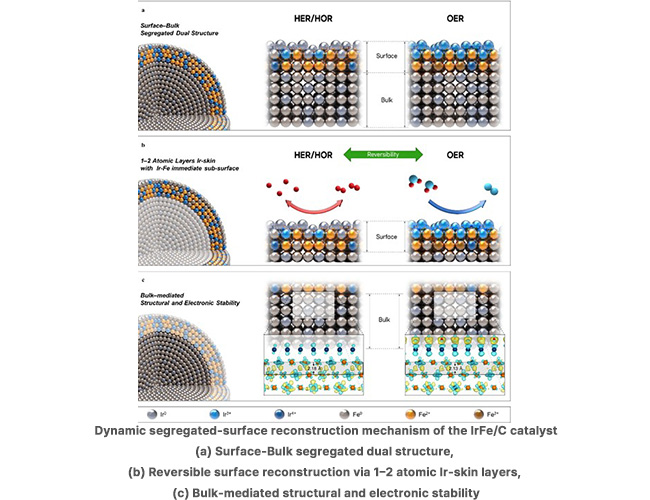
The team tackled this challenge by designing an IrFe/C electrocatalyst with a unique spatially segregated architecture, where the surface and the bulk of the catalyst nanoparticle play distinct roles. Under oxidative conditions, only the surface layer undergoes reversible changes in oxidation state, while the robust metallic alloy core remains structurally intact. The surface independently reconstructs in response to varying electrochemical environments, enabling it to dynamically regenerate its catalytically active metallic state after oxidation. This mechanism—termed "dynamic segregated-surface reconstruction"—achieves intrinsic reversibility by decoupling the catalyst’s surface from its bulk.
When the IrFe/C catalyst was applied to practical polymer electrolyte membrane water electrolyzers (PEMWE) and fuel cells (PEMFC), it demonstrated remarkable durability. While conventional Pt/C catalysts suffered a severe 62% performance drop after shut-down protocol tests, the IrFe/C-based MEA showed only a mild 16% decrease. The IrFe/C catalyst also exhibited outstanding stability under fuel starvation and SU/SD conditions in fuel cells, with minimal degradation of the cathode catalyst layer thickness compared to conventional systems.
Professor Yong-Tae Kim remarked, “This study introduces a new paradigm for overcoming surface passivation by establishing a sustainable strategy that promotes facile recovery and fundamentally addresses the critical bottleneck of electrocatalyst durability.” He added, “Our IrFe/C catalyst can be applied to both water electrolyzers and fuel cells, offering a versatile solution for the hydrogen energy industry.”
The research was supported by the Mid-career Researcher Program, the Nano & Material Technology Development Program, and the Sejong Science Fellowship from the National Research Foundation of Korea (NRF).
Researcher
-

Kim Yong-Tae Professor
Dept. of Materials Science & Eng.
View Profile