Research Highlights
Nanotube-Based Thermoelectrics Open a New Pathway to Waste-Heat Energy Conversion
- Electrical Engineering IT Engineering
- Date2026.06.18
- Views155
[POSTECH research team led by Professor Chang-Ki Baek reveals the mechanism
by which hollow-core nanotube structures suppress heat conduction through phonon localization]
Whenever someone asks ChatGPT a question, heat is generated somewhere in the server rooma data center. When an electric vehicle battery generates heat during operation, the heat must be managed continuously. Manufacturing processes also generate large amounts of waste heat, much of which is simply released into the atmosphere. But what if we could convert this waste heat back into electricity? Recently, a research team in Korea has brought this possibility one step closer to reality.
A research team led by Professor Chang-Ki Baek of the Department of Electrical Engineering and the Department of Convergence IT Engineering at POSTECH, along with Ki Yeong Kim, a Ph.D. candidate in the Department of Convergence IT Engineering, has identified a mechanism that could help overcome the efficiency limitations of thermoelectric devices that convert waste heat into electricity using a “hollow silicon nanotube” structure. The findings were published in Nano Energy, a leading international academic journal in the field of energy and nanotechnology.
Thermoelectric devices generate electricity using only temperature differences. The applications of this technology are extensive, ranging from waste heat recovery in industrial facilities to battery cooling and even nuclear batteries used to power space probes. As artificial intelligence continues to advance and thermal management in data centers becomes an increasingly important global challenge, the importance of thermoelectric technology is greater than ever.
The problem lies in the materials. Major thermoelectric materials generally rely on rare metals such as bismuth (Bi) and tellurium (Te). Because these elements are scarce and vulnerable to supply-chain instability, their prices and availability can fluctuate whenever global conditions become uncertain. On the other hand, silicon is abundant on Earth and is highly compatible with existing semiconductor manufacturing processes. However, there is one major reason why silicon-based thermoelectric devices have not been commercialized to date: their efficiency is too low.
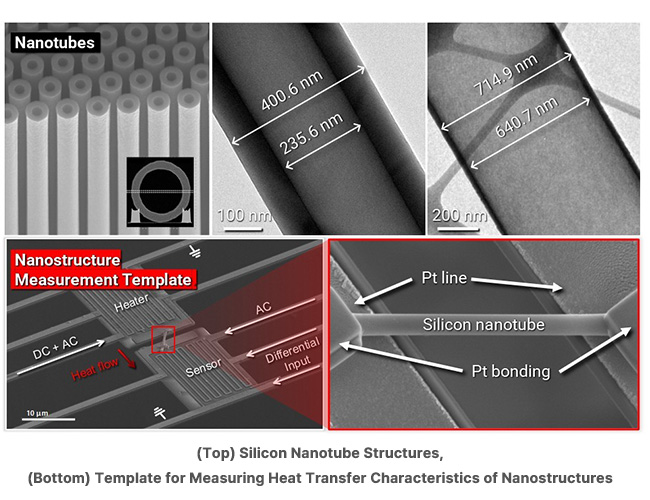
To improve the efficiency of thermoelectric devices, two conditions must be satisfied simultaneously. In other words, heat transport must be minimized while electrical transport remains efficient. However, as structures become smaller, heat conduction decreases, but electrical conductivity tends to decrease as well. Much like a barrier blocks both noise and airflow, these two characteristics are difficult to control independently.
The research team addressed this challenge by using a "hollow structure". While conventional nanowires1) are solid rod-shaped, nanotubes are hollow inside, much like small pipes. Comparing the two structures, nanotubes exhibited thermal conductivity about 70% lower than that of nanowires. An even more striking result emerged when the surface area ratio of the two structures was controlled to be the same. Although similar thermal performance would normally be expected under such conditions, the nanotube still exhibited thermal conductivity about 33% lower. This finding indicates that the hollow structure itself contributes an additional mechanism for suppressing heat transport.
The research team found the cause of this effect in "phonon2) localization." A phonon is a concept that represents vibrations that transfer heat within a solid as particles. Phonon localization means that these vibrations become confined to specific regions instead of spreading throughout the entire structure. This is similar to waves trapped behind a breakwater being unable to move forward. This study is the first to demonstrate that this phenomenon, previously believed to occur mainly under cryogenic conditions or highly specialized structures, can emerge in relatively simple nanotube structures at near-room temperature.
If the mechanism identified in this study can be translated into practical applications, it could open new opportunities to improve energy efficiency by converting wasted heat into electricity. This technology could also direct to industrial development because it can be implemented using established semiconductor manufacturing processes without relying on rare metals. Professor Chang-Ki Baek of POSTECH stated, “Because this technology is highly compatible with domestic semiconductor manufacturing technology, this approach can contribute to leading the next-generation thermal management market without relying on rare materials.”
▶️ DOI: https://doi.org/10.1016/j.nanoen.2026.112007
1. nanowire: A thin cylindrical nanostructure with a diameter on the order of nanometers.
2. phonon: A phonon is a quasiparticle that represents the collective vibration of atoms in a solid and serves as a carrier of heat.
Researcher
-

Baek Chang-Ki Professor
Dept. Convergence IT Eng.
View Profile -

Ki Yeong Kim
MS/PhD integrated program