Research Highlights
Nanoparticle Exsolution Opens a New Route to Functional Oxide Electronics and Spintronics
- Materials Science & Engineering
- Date2026.06.23
- Views47
[Researchers demonstrate a giant insulator-to-metal transition and room-temperature superparamagnetism
by controlling defect reconstruction and nickel nanoparticle formation in perovskite oxide thin films]
A research team led by Professor Hyeon Han and Professor Donghwa Lee from the Department of Materials Science and Engineering at Pohang University of Science and Technology, together with Professor Sang Ho Oh’s group at Korea Institute of Energy Technology, has developed a new strategy to simultaneously control the electronic and magnetic properties of oxide thin films through a process known as exsolution.
Exsolution is a process in which metal ions embedded within an oxide crystal migrate to the surface under reducing conditions and precipitate as metallic nanoparticles. Because these nanoparticles are partially anchored in the oxide lattice, they are more thermally and chemically stable than those deposited by conventional methods. For this reason, exsolution has attracted significant attention in energy-related applications such as catalysis, fuel cells, and electrolysis. However, how exsolution affects the intrinsic electronic and magnetic properties of oxide materials has remained insufficiently understood.
To address this question, the research team focused on La0.2Sr0.7Ni0.1Ti0.9O₃-δ, a well-known A-site-deficient perovskite titanate composition known to promote B-site cation exsolution into metallic nanoparticles. By combining comprehensive experimental characterization with density functional theory calculations, the team revealed that this material contains multiple types of defects, including strontium vacancies, oxygen vacancies, lanthanum substitution, and nickel substitution. In the pristine state, these defects electrically compensate one another, resulting in charge-compensated insulating state.
After exsolution, however, nickel nanoparticles form both within and on the surface of the flim, and the resulting defect reconstruction in the oxide lattice drives a marked change in the electronic structure. The lattice evolves toward a La-doped SrTiO3-like phase, resulting in a heavily electron-doped, degenerate metallic state. This transformation leads to a giant insulator-to-metal transition with a resistivity change exceeding three orders of magnitude. These results show that exsolution is not merely a method for generating metal nanoparticles; it can also fundamentally modify the electronic structure of the host oxide lattice.
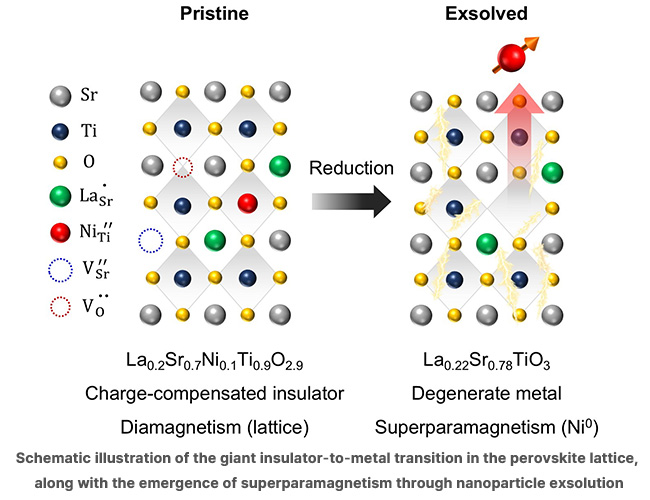
The team also observed a striking change in magnetic properties. While the pristine film exhibited nearly diamagnetic behavior, the exsolved film showed room-temperature superparamagnetism, arising from interactions among the newly formed Ni nanoparticles. This demonstrates that exsolution can simultaneously tune both the electrical behavior of the perovskite oxide matrix and the magnetic response of embedded metallic nanoparticles.
“This study shows that exsolution can go beyond nanoparticle formation and act as a versatile route to simultaneously control electronic and magnetic properties in oxide thin films,” said Professor Hyeon Han of POSTECH, who led the study. “By combining defect engineering with nanoparticle formation, this approach could open new design strategies for functional electronic and spintronic devices.”
This work was supported by the National Research Foundation of Korea funded by the Korean government, the POSTECH International Joint Research Project, the Max Planck Partner Group Programme, the Max Planck-Korea-PSI Center for Quantum Emergent Spintronics (KOMQUEST), and Samsung Electronics Co., Ltd.
Researcher
-

Han Hyeon Assistant Professor
Dept. of Materials Science & Eng.
View Profile -

Lee Donghwa Associate Professor
Dept. of Materials Science & Eng.
View Profile -

Hyojin Yoon
Dr.
-
Sungil Kim
master's program
-
Mongjun Jeong
MS/PhD integrated program
-
Haeseong Jeong
MS/PhD integrated program