Research Highlights
Wealthier and More Populated Metropolitan Areas Respond More Strongly to Early Drought News by Saving Water
- Environmental Science
- Date2026.07.10
- Views59
[POSTECH Professor Jonghun Kam’s research team, in collaboration with KRIHS, NDMI, Stanford University,
and the National University of Singapore (NUS), presents AI-based, region-specific water conservation scenarios using drought news data]
As climate change increases the risk of severe droughts, water resources management is an urgent challenge. Drought develops slowly, which makes the public aware of the ongoing drought. Governments rely on the media to communicate drought risks and encourage water conservation. However, it has remained unclear how much drought-related news actually contributes to water-saving behavior in different regions.
A research team led by Professor Jonghun Kam at POSTECH used explainable artificial intelligence (XAI) to analyze how drought-related news coverage influenced household water conservation during the 2022-2023 drought in southwestern Korea. The study, titled “Spatiotemporal and Economic Impacts of Media on Water Conservation during Drought: An Explainable AI Approach,” was published in Water Resources Research, a leading international journal in water resources.
Traditional hydrological models mainly focus on physical drought conditions, such as rainfall deficits and dam storage levels. However, drought response often depends on social factors, including public awareness, media coverage, and regional socioeconomic conditions. To capture interactions between natural and social systems, the research team developed AI models using household water use data, drought indices, dam storage levels, temperature, and drought-related news articles.
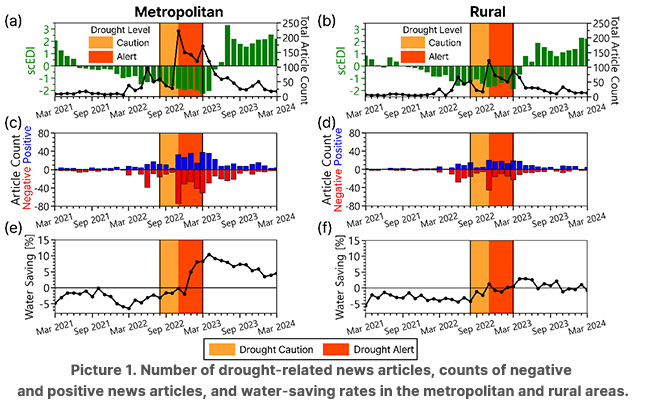
The team first calculated monthly water conservation rates by comparing actual household water use with average water use in the same month over the previous five years. The results showed that metropolitan areas with higher population density and income levels tended to show stronger voluntary water conservation during drought. In Gwangju Metropolitan City, water conservation rates increased by up to about 10%, while smaller cities and rural areas in Jeollanam-do showed increases of only about 3%.
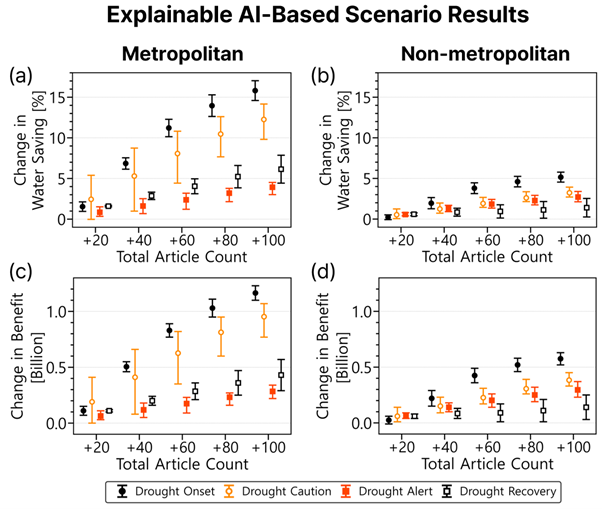
Among several AI models, the N-BEATS model predicted monthly water conservation rates with more than 73% accuracy in both metropolitan and smaller regions. The AI-based scenario analysis showed that when drought-related news coverage increased during the early and caution stages of drought, household water conservation in Gwangju increased by about 14 percentage points compared with the baseline. This corresponded to approximately USD 0.82 million in reduced tap water production costs. In contrast, the same increase in news coverage led to only about four percentage point increase in smaller cities and rural areas, equivalent to approximately USD 0.3 million in cost savings. This suggests that the impact of media coverage differs by region. Metropolitan households may have flexible water use and respond sensitively to drought information, while rural households may have limited room to further reduce basic domestic water consumption.
The study also found that the timing of media communication matters. News coverage had a stronger effect during the early and caution stages of drought, before conditions became severe. Once drought entered the alert stage, public concern and water conservation were already relatively high, leaving room for additional savings limited. This suggests that drought communication is effective when delivered early, rather than after the crisis has intensified.
Existing drought contingency policies are from a top-bottom approach applying uniform water conservation targets across drought-affected regions. This study provides a scientific basis for setting region-specific water-saving targets by considering both regional conditions and drought stages.
The first author, Eunmi Lee of POSTECH, said, “By using explainable AI, we are able to quantitatively reveal the hidden link between media coverage as a social factor and actual public water-saving behavior.” She added, “We hope that AI-based water resources research integrating environmental and social data will provide actionable information for developing effective, region-specific drought response strategies in climate crisis.”
This work was supported by a National Research Foundation of Korea (NRF) grant funded by the Ministry of Science and ICT (MSIT) (No. RS-2026-25470040) and by a grant (2022-MOIS63-001 (RS-2022-ND641011)) for Cooperative Research Method and Safety Management Technology in National Disaster, funded by the Ministry of Interior and Safety (MOIS, Korea)
Researcher
-

Kam Jonghun Associate Professor
Div. of Environmental Science & Eng.
View Profile -

Eunmi Lee
MS/PhD integrated program
-

Seunghui Choi
MS/PhD integrated program